Home › Blog › Metal Fabrication Companies UAE
Metal fabrication in the UAE covers a wide range of work, from structural steel and service platforms to gates, balustrades, facade brackets, pergolas and custom interior metalwork. Buyers in Fujairah and Dibba and in the east coast towns of Kalba and Khorfakkan often compare very different businesses under the same "metal fabrication" label, even though their capabilities, finishes and control over installation vary sharply. This guide explains how to tell them apart, using our own workshop in the Al Hail Industrial Area as a worked example.
The short version
- The best metal fabrication companies to shortlist in the UAE are the ones that can prove in house production, a clear installation scope and a good fit for your type of project.
- Separate real fabricators from traders: fabricated metal products are manufacturing work, and a real workshop can show you where it happens.
- A strong shortlist often mixes two kinds of business: large steel producers and structural specialists for heavy packages, and workshop led fabricators for architectural work such as gates, railings and facades.
- If a company cannot show where cutting, welding, finishing and coating happen, price alone is a weak way to decide.
- RFQs work better when they include dimensions, the finish specification, site conditions, and who owns shop drawings, transport and installation.
What counts as metal fabrication in the UAE?
Metal fabrication means turning raw or semi finished metal into components made for one project. International industrial classifications such as ISIC Rev. 4 place fabricated metal products under manufacturing, not trade, and that is the right way to think about it as a buyer.
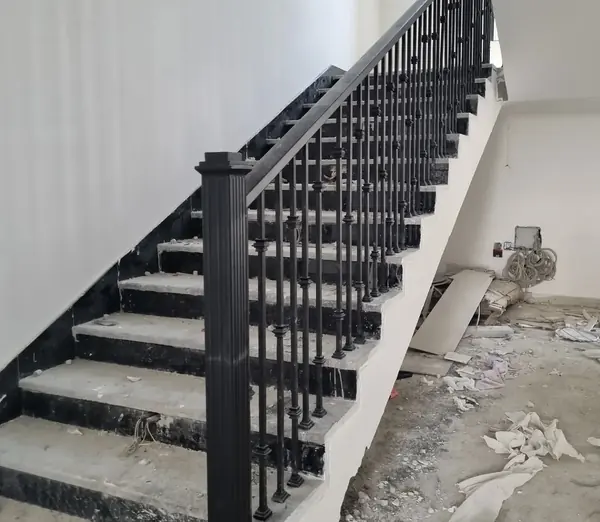
In practice, fabrication includes cutting, bending, welding, drilling, assembling, finishing and installing metal parts with a fixed purpose: a stair balustrade in a villa, a steel frame for a warehouse extension, aluminium doors for a commercial fit out, or brackets that support facade elements.
A common misunderstanding is that every steel seller is also a fabricator. That is not the case. If a job needs shop drawings, bespoke dimensions, anchor coordination, finish samples or installation sequencing, it has already moved beyond simple supply.
How can you check a metal fabricator before asking for a price?
The safest first screen is proof of in house production, control over installation on site, and a quick technical response.
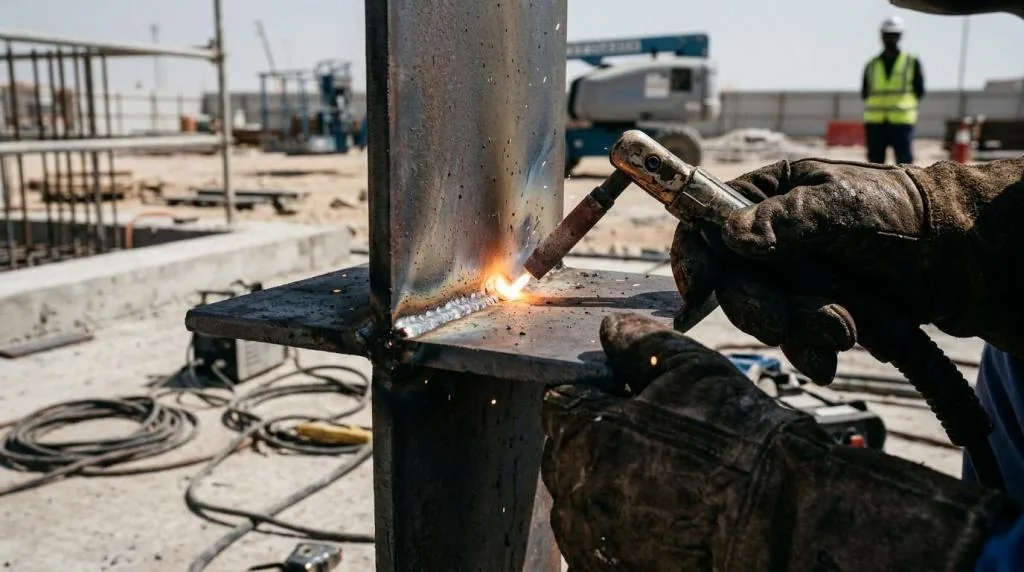
Start with physical capability. Ask where cutting, forming, welding, finishing and powder coating happen, and whether those stages stay under one management chain. If a provider fabricates in one place, coats in another and installs through a third party, each handover adds delay risk and variation in quality.
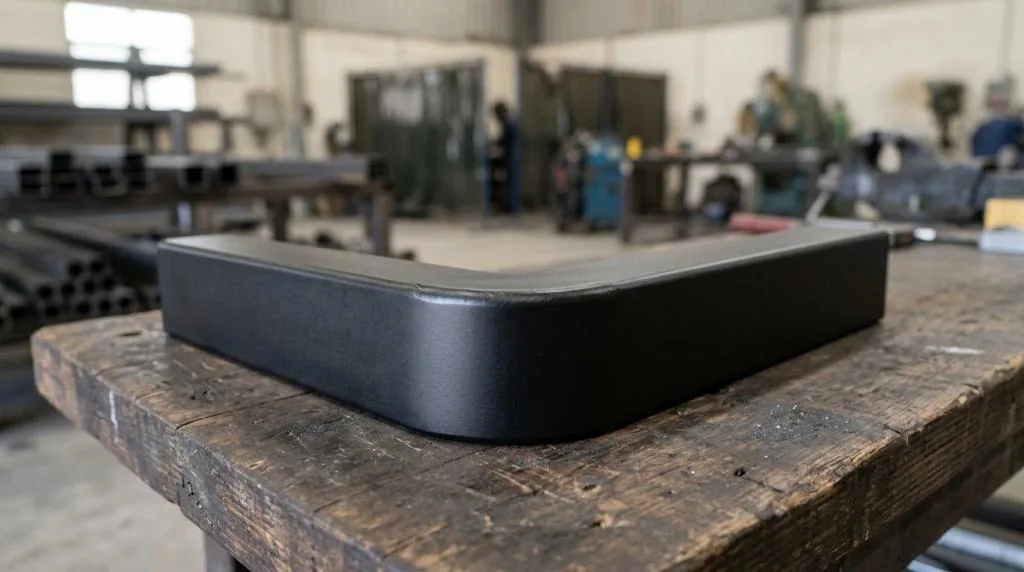
At Al Taher, cutting, forming, welding, finishing and powder coating are done in our own workshops in the Al Hail Industrial Area.
Next, look at documentation. A credible fabricator can discuss drawings, revision control, material grade, finish system, lead time and installation exclusions without drifting into vague answers. A fast quote is not proof of readiness. A useful quote is one that states its assumptions early, especially for access, fixing details and the finish build up.
Finally, check the project match. A company that is excellent at structural packages may be the wrong choice for decorative metalwork, and the reverse is also true. If the job includes glass, marble, joinery or powder coated architectural pieces, confirm that those interfaces are normal work for the company, not exceptions.
Which kinds of metal fabrication companies should you shortlist?
A practical shortlist is built by scope, not by name recognition. The UAE metal value chain has several distinct kinds of business, and each suits different packages.
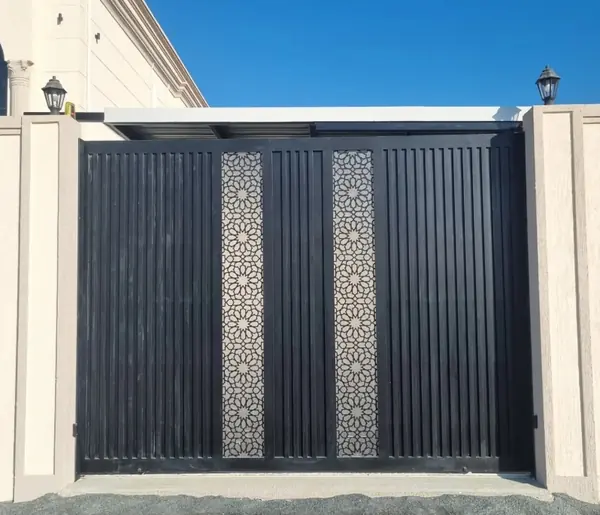
- Workshop led architectural fabricators (this is us): gates, railings, balustrades, pergolas, facade brackets and custom metalwork, with powder coating and installation from one base.
- Large steel producers: the upstream mills and building materials groups that supply flat and long steel. They set the material, not the finished piece.
- Structural steel fabricators and erectors: heavy frames, mezzanines, industrial buildings and technically demanding structures, usually priced by tonnage.
- Suppliers of prefabricated building systems: standard warehouse and shed systems designed around catalogue components rather than bespoke details.
- Coated steel and roofing producers: relevant when coated sheet affects roofing, cladding or related packages.
A shortlist is only the start. The better question is always: which of these companies routinely builds this exact package?
Should you choose in house fabrication or a subcontracted chain?
In house fabrication gives tighter control over drawings, welding, finishing and delivery. Subcontracted chains can work for very large or niche jobs, but they add risk at exactly the points where errors appear.
When one fabricator controls the workshop and the installation team, communication is shorter. Design changes move faster from drawing revision to production, and finish problems can be traced to one accountable team. If a powder coated handrail arrives with a mismatched colour, or with weld marks showing through the finish, you know where responsibility sits.
Subcontracting is not automatically bad. It can be the right choice when a project needs specialist laser cutting, heavy galvanising or unusual profiles that a smaller workshop does not keep in house. We use specialist partners for laser cutting ourselves, while we cut on our own CNC machine and do the welding and coating in house. The trade off is visibility, so ask who fabricates, who inspects and who signs off before dispatch.
How does structural steel supply differ from architectural metal fabrication?
They solve different problems. Structural packages start with tonnage, member sizes, engineering and the erection sequence. Architectural fabrication starts with dimensions, appearance, touch points, finish consistency and the interface with glass, cladding, joinery or stone. The tools overlap, but the commercial logic is different.
That difference shows on residential and commercial work across Fujairah and the east coast. A stair railing or an aluminium and glass partition depends on final site dimensions, slab conditions and finish approval. One kind of job is led by engineering, around loads and erection. The other is led by detail, around fit, finish and coordination.
We offer a free site visit within 48 hours and an itemised quotation within 24 hours of the visit.
How do you write a metal fabrication RFQ, step by step?
A usable request for quotation includes drawings, dimensions, finish, site conditions and installation scope. If any of those are missing, every price you receive is provisional, even when the suppliers use the same base metal.
- Technical clarity: what is being made, from which metal, at what thickness, with which finish, and to which dimensions or tolerances.
- Interface clarity: whether the fabricator is responsible for embeds, anchors, sealants, glass openings or coordination with other trades.
- Logistics clarity: delivery dates, floor access, crane needs and working hours, all of which can change the price.
The most reliable RFQs come with a compact information pack:
- Drawing set: plans, elevations, details and revision status.
- Finish schedule: galvanised, painted, powder coated, stainless grade or brushed finish.
- Site conditions: access limits, lifting method, working hours and the condition of existing walls or slabs.
- Commercial scope: transport, installation, protection, snagging and exclusions.
If the RFQ is vague, suppliers fill the gaps with assumptions, and that is where the cheapest quote often becomes the most expensive order.
How can you check quality before production starts?
Quality control before production starts with drawings, mock ups and finish approval. Standards only help when the workshop turns them into weld details, tolerances, fixing logic and approved samples.
The first control point is the shop drawing: dimensions, connection details, opening directions, clearances and fixing methods should be signed off before cutting starts. The second is the sample. If the job includes powder coating, visible welds, stainless finishing or decorative patterns, a small mock up or finish sample prevents a problem across the whole batch.
The third is inspection planning. Agree hold points for material receipt, trial assembly, finish approval and checks before dispatch. If a component will be touched, seen up close or installed next to glass or marble, its appearance matters as much as its strength. Many disputes start because one side inspected for strength while the other expected a furniture grade finish.
What changes the price, lead time and finish of metal fabrication?
Thickness, complexity, the finish system and installation access drive most of the cost. Powder coating, stainless selection, curved work and night installation can each shift the price well before transport is added.
Two quotes can differ sharply even when the drawings look alike. A mild steel gate with a simple painted finish is not priced like a decorative cut panel with hidden fixings and powder coating. Stainless steel changes both material cost and finishing labour, and welding on site adds risk, protection and touch up work. Near the sea, as in Fujairah, Dibba and the east coast towns of Kalba and Khorfakkan, corrosion protection is a design decision, not a small extra.
- If the design changes late: expect rework cost, a delay while drawings are revised, and possible material waste.
- If appearance is critical: allow time for sample approval, weld dressing and finish inspection.
- If access is tight: expect extra labour, smaller fabrication modules or special lifting plans.
- If one supplier controls fabrication and installation: expect clearer accountability, and weigh that against specialist outsourcing when the scope is unusual.
The best buying decision is rarely the lowest unit rate. It is the offer that matches the risk of the project, the finish you expect and the handover date.
Itemised quotation within 24 hours of the visit, no charge and no obligation.
Buying a gate or a door rather than a fabrication package? See how to compare gate and door manufacturers.
Frequently asked questions
What should I ask a metal fabrication company before getting a quote?
Ask where cutting, welding, finishing and coating happen, who installs, and how drawings and revisions are controlled. A company that does the work itself can answer all three clearly and show you the workshop.
Are metal fabricators and steel suppliers the same thing?
No. A steel supplier sells material; a fabricator turns it into finished parts for a specific project, with drawings, finishing and usually installation. Some companies do both, so check which part of the job they actually perform.
Do you work in Dibba, Kalba and Khorfakkan?
Yes. We fabricate in the Al Hail Industrial Area in Fujairah and install in Dibba and in the east coast towns of Kalba and Khorfakkan, as well as across the rest of the UAE.
What should a metal fabrication RFQ include?
Drawings with their revision status, a finish schedule, site conditions and the commercial scope: transport, installation, protection, snagging and exclusions. Without them, every price you receive is provisional.
Do you take metal fabrication work in Hatta and Masafi too?
Yes. We take metal fabrication work in Hatta, in the east coast towns of Kalba and Khorfakkan, and all over Fujairah, including Dibba, Masafi, Al Bidiyah and Mirbah. Fabrication, welding and powder coating happen in our Al Hail workshop and our own crew installs on site, so a job in Kalba or Hatta runs like one in Fujairah. The site visit is free, and the itemised quotation follows within 24 hours.