Home › Blog › Welding Services UAE
Choosing welding services in the UAE for site work is less about finding the cheapest welder and more about finding a team that can measure, fabricate, weld, inspect and install under project controls. Al Taher Group is a Fujairah based fabrication and fit out group serving all seven emirates, and site welding jobs usually depend on workshop support and accountable installation rather than labour on site alone.
The short version
- The best welding services UAE teams for site work combine documented welding procedures, site measurement, workshop fabrication and installation under one accountable workflow.
- In Dubai, welding works can require consultant approval of the welding control and quality system, plus approval before welding starts on site.
- Al Taher Group fits the site work category because fabrication and installation are handled in house across all seven emirates, which reduces handoff risk between workshop and site.
- ISO 3834 covers welding quality requirements in workshops and field installation sites, while AWS treats welder certification as a performance based test tied to a welding procedure specification.
- If a contractor cannot show procedure control, trained personnel, inspection records and a clear scope for hot work, access and finishes, the lowest quote is often the highest risk option.
This matters in 2026 because UAE projects keep moving toward tighter approvals, better traceability and fewer trade handoffs. A good site welding team is usually the one that can turn drawings and measurements into installed metalwork without losing quality control between the workshop and the job site.
What makes a welding service suitable for UAE site work?
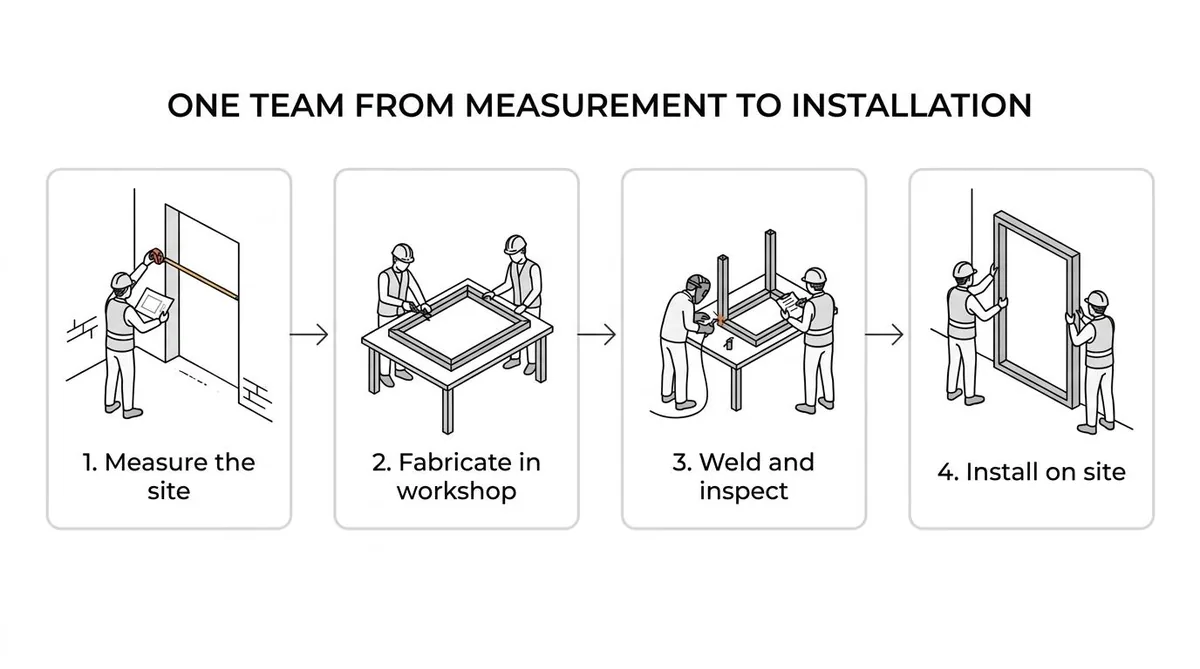
The strongest UAE site welding teams combine skilled welders, a documented procedure and workshop backed fabrication. A team is most useful when it can measure on site, fabricate off site and return for installation without passing the work to a third party.
Site welding in the UAE sits between fabrication, structural coordination, fit out sequencing and safety control. That is why buyers should look past a basic "we do welding" claim. The real test is whether the contractor can manage material selection, tolerances, welding procedure, inspection, finishing, transport and installation as one package.
ISO 3834 is a useful reference because it applies to fusion welding of metallic materials in both workshops and field installation sites. That distinction is practical. A team with only mobile welders may still struggle if brackets, frames, gates, balustrades or canopies need accurate prefabrication, drilling, forming or powder coating before final fixing.
A common mistake is treating a site welding package as labour only. On many UAE projects the hard part is not striking the arc. It is controlling dimensions, approvals, finishes and rework risk when metal meets concrete, blockwork, glass or aluminium already installed by other trades.
Why do consultant approvals and welding procedures matter in Dubai and Fujairah?
They matter because welding on a UAE project can be a controlled activity rather than an informal repair job. In Dubai, building requirements state that the contractor must obtain consultant approval for the proposed welding control and quality system before welding works begin, and approval before welding on site.
Fujairah and the northern emirates apply their own municipality processes, and requirements vary by project scale and consultant. The practical point is the same wherever you build: ask early whether the package needs consultant sign off before site welding starts. That single question usually reveals whether a team is thinking like a contractor or like a day rate welder.
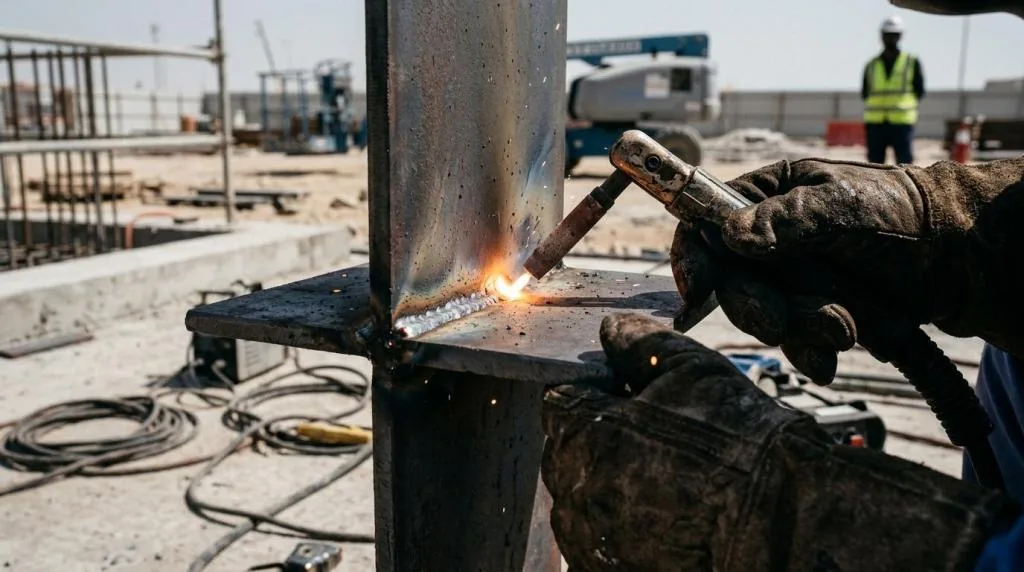
The same Dubai requirements also state that personnel involved should be adequately trained to document agreed welding procedures and record weld inspection findings. If the work is architectural metalwork, procedure still matters because heat input, distortion, grinding quality and final finishing all affect how the metal looks once installed.
Which welding setup suits which job?
There is no single best team, only a best fit for the package. The right choice depends on whether the job is structural steel, architectural metalwork, fit out support, facade tie ins, villa works or live site modification.
- Structural steel erection suits heavy frames, beams and steel packages tied to shop drawings and erection sequencing.
- Architectural metalwork fabrication suits railings, gates, pergolas, decorative screens, canopies and stair details where finish quality decides the result.
- Fit out metalwork covers partitions, support frames and service access panels inside mixed scope interior packages.
- Aluminium and steel hybrid work matters when steel supports connect to glazing, cladding, shopfronts or aluminium frames.
- Plant and maintenance welding suits repairs, equipment supports, utility areas and industrial modifications.
- Mobile site crews with workshop backing suit remote or urgent works, provided procedures, measurements and inspection are still documented.
A frequent misconception is that the strongest team is the one with the biggest workshop. For site work the better question is whether the setup matches the package. A villa gate replacement needs a different workflow from a facade bracket package or a warehouse steel alteration. We cover the architectural, fit out and hybrid categories from our own workshop in Fujairah.
How should scope be defined before work starts?
A reliable process starts with site verification, then drawing control, then fabrication planning. Skipping the first two steps is the fastest way to create rework on a UAE site.
Step one is the site visit. The team should verify actual dimensions, substrate condition, access routes, power availability, finish interfaces and whether hot work permits are needed. If the site is occupied, then timing, noise, fumes and isolation zones matter immediately.
Step two is scope definition. That means identifying material grade, section size, connection type, welding method, fixing details, surface preparation, coating system and whether any welds will be visible after installation. This is where cheap quotes stay vague. If a quote does not say what finish is included, assume grinding, primer, touch up or powder coating repair may become variations later.
Step three is fabrication planning. The team should decide what can be built in the workshop and what must be welded on site because of transport, tolerance or access limits. Ask for a simple mark up showing workshop welds against site welds. That one document prevents a week of argument later.
Workshop welding or site welding?
Workshop welding wins on consistency, fixturing and finish control. Site welding wins on final tie ins and tolerance adjustment. Most good UAE projects use both rather than one or the other.
In a workshop, jigs, flat surfaces, cutting tools and controlled handling reduce distortion and dimensional drift. Surface preparation is easier too, which matters if the steel will be powder coated, painted or integrated with glass and aluminium. ISO 3834 covering both workshop and field sites is useful here, because quality requirements should not evaporate once metal leaves the factory.
On site, the team gains real world fit. They can deal with slab deviations, embed misalignment, existing finishes or late design changes. The trade off is that weather, access, live operations, permit windows and fire precautions make quality control harder. Many buyers assume site welding is always faster. It is not. Where repeated cutting, fitting and rewelding happen under poor access, a prepared workshop assembly usually saves more time.
How can clients verify competence before awarding work?
Ask for procedure, personnel and inspection records, and judge any contractor on documents as much as on finished metalwork. In site welding, visible metalwork can still hide poor process control.
Check the procedure path first. Ask what welding procedure applies, what material and thickness range it covers, and whether the project has consultant or engineer review requirements. That is far more useful than a vague question about experience.
Then check welder competence. AWS frames certified welder testing as a performance based test tied to a specific welding procedure and code requirement, carried out at an accredited test facility. A welder's proof of ability should therefore connect to the process and position being used, not rest on a general claim of being certified. Where a project requires formally certified welders to a named code, say so at enquiry stage so contractors can confirm whether they hold that qualification.
Finally check inspection and recordkeeping. Ask who records weld inspections, who signs off touch ups and how non conforming work is handled. Asking only for photos is a common mistake. Photos help, but they do not replace procedure control, personnel records and inspection logs when a consultant asks questions later.
Which welding methods and metals are common on UAE sites?
MIG, TIG and stick welding are the usual site methods, and mild steel, stainless steel and aluminium are the common project metals. The best method depends on the joint, thickness, finish requirement and site conditions.
MIG is common for general steel fabrication because it is productive and suits gates, railings, frames and support brackets. TIG is slower but cleaner, which suits visible stainless steel details where appearance matters. Stick welding still earns its place on site for certain repair or erection conditions, particularly where access is awkward and wind disturbs shielding gas.
A frequent misconception is that one process is always stronger than another. Strength depends on correct procedure, joint design, preparation, filler and execution. Stainless steel handrails, mild steel bollards, aluminium frames and steel to concrete connection plates each ask for different control points. If the project includes galvanised steel, welding and touch up treatment need early planning because coating damage at weld areas must be handled properly after installation.
How should safety and access be managed on site?
Safe site welding needs hot work controls, ventilation, PPE and a realistic access plan before the first cut or tack. AWS is clear that safe welding practice includes PPE, ventilation, fire prevention and safe equipment operating procedures, with employers responsible for workplace safety.
Permit and area control comes first. Confirm hot work permits, spark containment, nearby combustible materials and fire watch requirements. If welding happens near joinery, waterproofing or finished cladding, then shielding and timing become part of the method rather than an afterthought.
Ventilation and equipment setup comes next. Indoor welding around shafts, plant rooms, kitchens or enclosed service areas needs attention to fume movement and safe cable routing. Ask where gas bottles, leads and grinding stations will sit before work starts. That small question often reveals whether the plan is workable.
Access sequencing comes third. Scaffolds, mobile platforms or boom lifts must suit the weld position and the inspection line of sight. The same planning logic appears in 4CAD’s overview of 3D building scanning, which shows how accurate capture of existing conditions reduces fit up surprises before fabrication begins. Many site defects start with bad access rather than bad welding. If the operator cannot hold correct angle, visibility and stability, quality drops before anyone notices.
Which projects benefit most from one accountable team?
Projects with interfaces, visible finishes or tight tolerances benefit most. Villas, shopfronts, staircases, pergolas, balustrades, facade supports and mixed metal and glass packages are the common examples.
This model works because measurement, fabrication and installation affect each other directly. A staircase railing may need exact site dimensions taken after marble installation. A pergola may need workshop fabrication for straightness, then site welding or bolting to tie in at existing columns. A shopfront support frame may need steel, aluminium and glass trades coordinated in the right order.
The trade off is that a single accountable team is not always the lowest bidder. Even so, it removes disputes over who measured wrongly, who altered the detail and who damaged the finish. For homeowners and developers across Fujairah, Dubai and the wider UAE, that accountability usually matters more than saving a small amount on day one price.
How should you compare welding quotes?
Compare line by line rather than by total price. Two welding quotes can differ sharply in preparation, approvals, finish quality and site responsibility even when the headline description looks identical. Check these before signing:
- Scope basis: measured on site, taken from drawings only, or provisional quantity
- Welding control: stated procedure, inspection records and responsibility for consultant comments
- Finishes included: grinding, primer, galvanising repair, paint touch up or powder coating touch up
- Installation access: scaffold, lifting equipment, coring, drilling and debris removal
- Handover standard: visible weld finish, tolerance expectations, snag rectification and protection of nearby finishes
If one quote is far cheaper, ask what has been excluded. That is not a hostile question, it is standard commercial control. A low number may still be the right number, but only if the contractor priced the same material grade, thickness, finish, access method and responsibility for site welding approvals. On UAE projects, welding value is rarely the weld itself. It is the full chain from measurement to installed, inspected metalwork.
Itemised quotation within 24 hours of the visit, no charge and no obligation.
Frequently Asked Questions
What should I look for in a welding service in the UAE?
A team that can measure on site, fabricate in its own workshop, weld to a documented procedure, inspect the work and install it, all under one accountable scope. Judge on procedure control, personnel, inspection records and a clear finish specification rather than on day rate alone.
Do welding works in Dubai need consultant approval?
They can. Dubai building requirements state that the contractor must obtain consultant approval of the welding control and quality system before welding works, and approval before welding on site. Requirements vary by project and emirate, so confirm at enquiry stage whether your package needs sign off.
What is ISO 3834 and why does it matter?
ISO 3834 sets quality requirements for fusion welding of metallic materials, and it applies to both workshops and field installation sites. That matters because quality control should not lapse once fabricated metalwork leaves the factory for site.
Is workshop welding better than site welding?
They solve different problems. Workshop welding gives better consistency, fixturing and finish control. Site welding handles final tie ins, slab deviations and tolerance adjustment. Most projects need both, and the useful document is a mark up showing which welds happen where.
MIG, TIG or stick welding, which is best?
It depends on joint, thickness, finish and site conditions rather than one being universally stronger. MIG suits general steel fabrication such as gates, railings and brackets. TIG is slower and cleaner for visible stainless steel. Stick still works well on site where access is awkward or wind disturbs shielding gas.
Do you cover welding across the UAE or only Fujairah?
All seven emirates. Fabrication happens in our Fujairah workshop and installation is carried out by our own crews in Fujairah, Dubai, Sharjah, Abu Dhabi, Ajman, Ras Al Khaimah and Umm Al Quwain.