Home › Blog › Office Fit Out in Dubai: Choosing a Contractor
An office fit out in Dubai is won or lost on permits, coordination and programme control, not on the render. Handover dates depend on approvals landing, services coordinating cleanly, and one party being accountable when trades meet. Al Taher Group fabricates the metal, glass, aluminium and joinery scope in-house from its Fujairah workshop and installs across Dubai, Kalba, Khorfakkan and all seven emirates.
The short version
- Permit responsibility is the first question. Ask who prepares, submits and chases approvals.
- MEP coordination causes more delay than joinery ever does.
- In-house fabrication removes the handoffs where programme and quality usually slip.
- Compare scope, not totals. The cheapest number is usually the least complete one.
- Ask for a written snagging protocol and a defect rectification window before signing.
Who is responsible for permits?
Ask it in exactly those words and listen to how specific the answer is. A contractor who names the authority, the submission stages and a realistic approval window is telling you they have done it. A contractor who says approvals are straightforward is telling you something else.
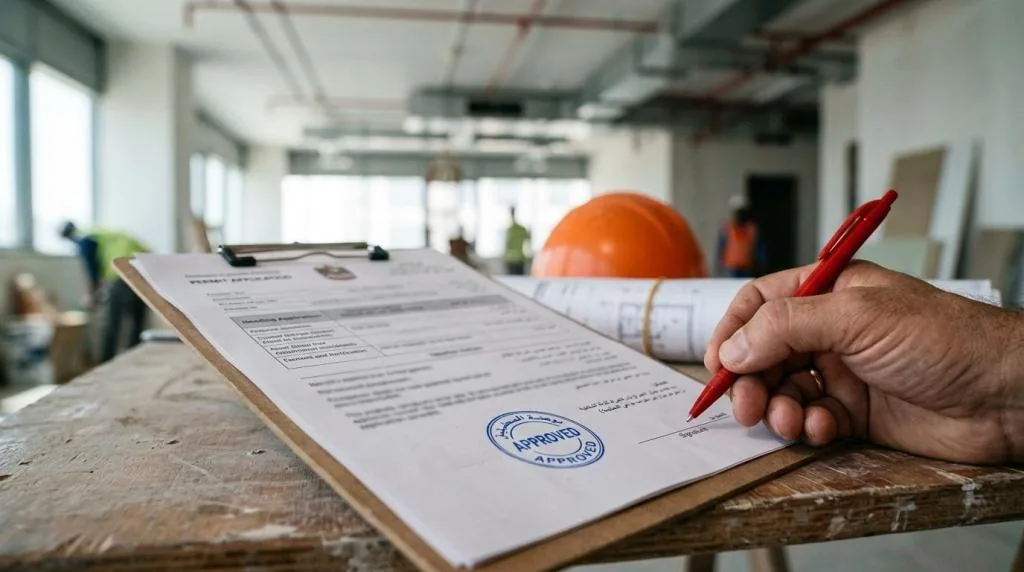
Fit out works in Dubai typically need approval before work starts, and the route depends on whether the building sits under the municipality or a free zone authority, each with its own process and timelines. That difference matters to your programme, so it should be established at tender stage rather than discovered in week two.
Which contractor profile fits your project?
Rather than ranking firms, screen against the profile your job actually needs. Most fit out contractors sit in one of these shapes, and the right one depends on your scope.
- The in-house fabricator. Owns workshop production for joinery, metal, glass and aluminium. Strongest where bespoke elements and finish consistency drive the result, and where fewer handoffs matter more than headcount.
- The MEP-led contractor. Built around services coordination. Right where the office is services-heavy, with significant HVAC alteration, dense power and data, or complex ceiling voids.
- The design and build firm. Carries concept through to delivery under one contract. Suits clients without an appointed designer who want a single point of responsibility from the first sketch.
- The turnkey main contractor. Manages a broad subcontractor base across large floor plates. Suits multi-floor or multi-site programmes where management capacity is the constraint.
- The specialist joinery house. Deep bespoke furniture and millwork capability, usually working alongside a main contractor rather than instead of one.
- The fast-track refurbishment specialist. Geared to occupied premises, phased works and out-of-hours programmes where the office keeps running throughout.
- The compliance-led contractor. Organised around authority approvals and documentation. Valuable where the building or activity carries a heavier regulatory load.
We sit in the first category, and we are candid about it. Where a project is overwhelmingly MEP-driven, a services-led contractor may be the better lead with our scope running underneath.
Why does MEP coordination decide the programme?
Because ceilings are where everything collides. HVAC ducts, sprinkler runs, lighting, cable trays and structural soffits all compete for the same void, and if that is resolved on site rather than on drawings, partitions wait and the programme slips.
Ask how services coordination is handled and at what stage. A contractor who coordinates before partitions go up is managing risk. One who resolves clashes as they appear is absorbing your float. This is also where glass partitions complicate things, because a full height partition can change detector layout and require Civil Defence input.
What does in-house fabrication actually change?
It removes the interfaces where fit out projects usually go wrong. When joinery, metalwork, glazing and aluminium come from one workshop, the reception desk, the partition frames, the door sets and the feature metalwork share one finish schedule and one delivery programme.
The alternative is four suppliers with four lead times and four standards of what a colour match means. On a site where the client walks the space weekly, that difference is visible. We also run our own powder coating line, so metal elements across a whole fit out pass through the same colour batch rather than being matched by eye.
How should you compare quotes?
Normalise scope first, then compare. Fit out quotes diverge because of what they exclude, not because of margin. Check each one states:
- Permits and approvals — who prepares, submits and pays, and whether authority-driven revisions are included
- MEP scope — what is included versus assumed as existing, and who coordinates
- Specification level — named finishes, board types, hardware and glass specs rather than allowances
- Site logistics — access hours, lift bookings, protection, waste removal and out-of-hours working
- Handover — snagging protocol, defect rectification window and as-built documentation
Where one quote is materially cheaper, the useful question is not why it is low but what it leaves out. Ask it directly and plainly. Any contractor worth appointing will answer it without defensiveness. Our fuller fit out guide →
Itemised quotation within 24 hours of the visit, no charge and no obligation.
Frequently Asked Questions
Who is responsible for fit out permits in Dubai?
It depends on the contract, which is why it should be settled at tender stage. Ask who prepares, submits and chases approvals, and whether authority-driven revisions are included. The route differs between municipality-governed buildings and free zone authorities, each with its own process.
What causes most office fit out delays?
MEP coordination, not joinery. Ducts, sprinklers, lighting, cable trays and structural soffits compete for the same ceiling void, and resolving those clashes on site rather than on drawings is what holds up partitions and pushes handover.
Does in-house fabrication matter for an office fit out?
It removes the interfaces where projects usually slip. Joinery, metalwork, glazing and aluminium from one workshop share one finish schedule and one delivery programme, instead of four suppliers with four lead times and four interpretations of a colour match.
How do I compare office fit out quotes fairly?
Normalise the scope before the totals. Confirm permits, MEP inclusions, named specifications rather than allowances, site logistics and the handover protocol. Quotes diverge on exclusions far more often than on margin.
Do you take on full office fit out or only part of it?
Both. We deliver the metal, glass, aluminium and joinery scope as a package under a main contractor, and we take full fit out packages where that scope dominates. Where a job is overwhelmingly MEP-driven we will say so.
Do you work in Dubai from a Fujairah workshop?
Yes. Fabrication happens in Fujairah, installation is by our own crews, and we work across Dubai, Kalba, Khorfakkan and all seven emirates. Any transport line appears as its own item in the quotation rather than hidden in the rates.