Home › Blog › CNC Metal Cutting in Dubai and Fujairah
CNC metal cutting turns a drawing into a cut part with repeatable accuracy, and it now runs on our own machine in Fujairah. That matters for decorative screens, gate infills, balustrade panels, brackets and signage across Fujairah, Kalba and Dubai, because the cut is only useful when the same workshop can form, weld, finish and install what comes off it.
The short version
- CNC cutting runs in-house on our own machine, alongside forming, welding, powder coating and installation.
- Vector files in DXF or DWG are what a cutting bed actually reads. A JPG or PDF has to be redrawn first.
- Sheet thickness and material decide the process, the edge quality and the price more than the pattern does.
- The cut edge is not the finished edge. Deburring, forming and coating are separate operations.
- For designs that specifically require laser cutting we still use specialist partner facilities.
What does CNC cutting actually do?
A computer-controlled head follows a digital path across a fixed sheet, cutting the profile exactly as drawn, every time. The value is not that it cuts, but that part forty is identical to part one. For a villa with eighteen matching balcony screens, or a facade with a repeating perforation, that repeatability is the whole job.
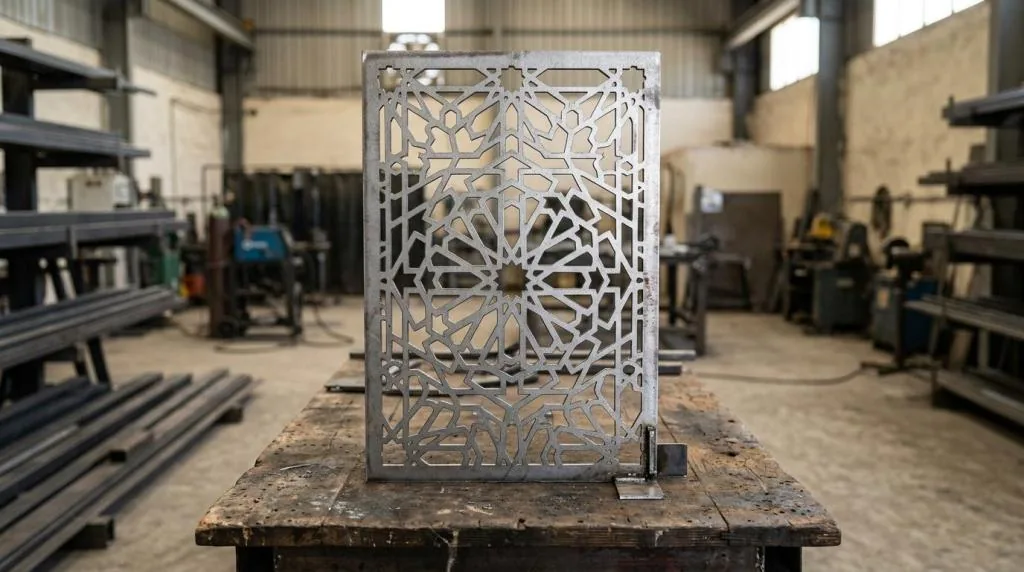
It also opens designs that hand cutting cannot reach: fine geometric patterning, tight internal radii, precise perforation grids, and text or logos cut cleanly into sheet.
What file do you need to send?
A vector file: DXF or DWG. Those describe the cut as lines and curves the machine can follow. A photograph, a JPG or a flattened PDF describes pixels, and someone has to redraw it as vectors before anything can be cut. That redraw is real work, and it is where quotes diverge when buyers assume a picture is enough.
If you have a sketch, a reference photo or a pattern you like rather than a drawing, say so at enquiry stage. We produce CAD drawings in-house when a project needs them, and we would rather price the drawing honestly than surprise you with it later.
Which material and thickness?
Mild steel is the workhorse for gate infills, screens and brackets, cut cleanly and then powder coated for the coastal conditions in Fujairah and Kalba. Stainless steel suits visible interior details and coastal exposure where corrosion resistance leads. Aluminium is lighter and rust-free, which is why it dominates pergola screens and facade panels near the sea.
Thickness drives everything downstream. Thin sheet cuts fast and cheap but flexes, so a large decorative screen in thin material needs a frame or it will oil-can in the wind. Heavier plate holds itself but costs more in material and cutting time. The right answer depends on panel size, span and whether the piece is structural or ornamental.
Why is the cut only the first step?
A cut part is not a finished part. Edges come off the bed with dross or burr that has to be removed, especially on anything people will touch. Parts that need to bend go to forming afterwards, and the bend allowance has to be built into the flat pattern before cutting, not discovered after.
Then the piece needs joining and finishing. A decorative screen usually needs a perimeter frame welded around it, fixing points added, and a coating applied. This is the reason cutting alone is rarely the useful purchase. A cutting shop hands you flat parts. A fabricator hands you an installed screen. Our fabrication division →
What do CNC cut parts get used for here?
- Decorative screens and privacy panels — the most common request, in geometric or custom patterning for villa facades, balconies and courtyards.
- Gate infill panels — patterned inserts within a fabricated gate frame, matched to the boundary fence.
- Balustrade infills — cut panels as an alternative to glass or vertical bars in stair and balcony railings.
- Brackets, plates and connection parts — repeatable structural components cut to drawing.
- Signage and lettering — cut from sheet, coated, and mounted.
What should you check before ordering?
Confirm five things and most cutting disputes disappear: the file format you are supplying and whether a redraw is priced; the material and thickness, not just the pattern; whether deburring and edge finishing are included; whether the price covers cutting only or the finished fabricated item; and the tolerance the job actually needs, because a decorative screen and a structural bracket are not held to the same standard.
We cut, form, weld, finish and install from the same workshop in the Al Hail Industrial Area, and deliver across Fujairah, Kalba, Khorfakkan and all seven emirates. Free site visit within 48 hours, itemised quotation within 24 hours of that visit.
Itemised quotation within 24 hours of the visit, no charge and no obligation.
Frequently Asked Questions
What file format do you need for CNC cutting?
A vector file, DXF or DWG. Those describe the cut as lines and curves a machine can follow. A JPG, photograph or flattened PDF has to be redrawn as vectors first, which is real work and should be priced openly rather than assumed.
Do you do CNC cutting in-house?
Yes, CNC cutting runs on our own machine in the Fujairah workshop, alongside forming, welding, powder coating and installation. For designs that specifically require laser cutting we work with specialist partner facilities.
Which metals can be CNC cut?
Mild steel for gate infills, screens and brackets, stainless steel where corrosion resistance and visible finish matter, and aluminium for lighter rust-free panels. Thickness affects edge quality, cutting time and price more than the pattern does.
Is the cut edge ready to use?
Not usually. Parts come off the bed with burr or dross that needs removing, especially on anything people touch. Pieces that bend go to forming afterwards, and most decorative work then needs a welded frame, fixing points and a coating.
Do you cut parts for other workshops?
Yes, subject to material, thickness and file suitability. Send the DXF or DWG with the material and thickness and we will advise on the site visit or over WhatsApp.
Do you deliver CNC work outside Fujairah?
Yes. Cutting and fabrication happen in our Fujairah workshop, and we deliver and install across Kalba, Khorfakkan, Dubai, Sharjah and all seven emirates with our own team.